
Rawdog your sleep
3 min read - all sources to this journal are listed at the bottom.
In 2014, two American researchers sat 164 people in a chair, hooked them up to electrodes,
and told them the equipment could read how well they'd slept the night before.
The equipment measured nothing. The numbers were written in advance.
Half were told they'd gotten 28.7 percent REM sleep, which is above average. The other half were told 16.2 percent, which is below. Then everyone did the same mental math and language tasks.
The people who believed they'd slept badly performed worse. The people who believed they'd slept well performed better. And here's the key part: it wasn't their actual sleep that predicted the result. It was the message.
The researchers called it placebo sleep. But really, it's a warning about what happens every single night.
What That Means Now That Everyone's Wearing a Tracker
There was no app in that study. No score, no graphs, no ring. There was a made-up number, and a person who believed it.
Today, millions of people wake up to a number like that — from an Oura ring, an Apple Watch, a Whoop band, a Garmin — before their feet even hit the floor. They believe it. And now we know what that costs.
Sleep doctors have even given it a name. In 2017, an American group described a new type of patient: people who didn't come in because they were sleeping badly, but because their tracker said they were. They'd read their own data, concluded they weren't getting enough deep sleep, and become genuinely worried about it. Doctors called the condition orthosomnia — the pursuit of perfect sleep that ends up ruining it.
The most striking part of that description: the patients trusted their tracker more than the sleep lab's actual test results. When the two disagreed, it was the lab that must have gotten it wrong.
What the Tracker Can Do, and What It Can't
We need to be precise here, because these devices aren't useless. They're just something different than people assume. And they're not all equally good: a watch on your wrist and a ring on your finger perform differently.
The watches and the wristbands
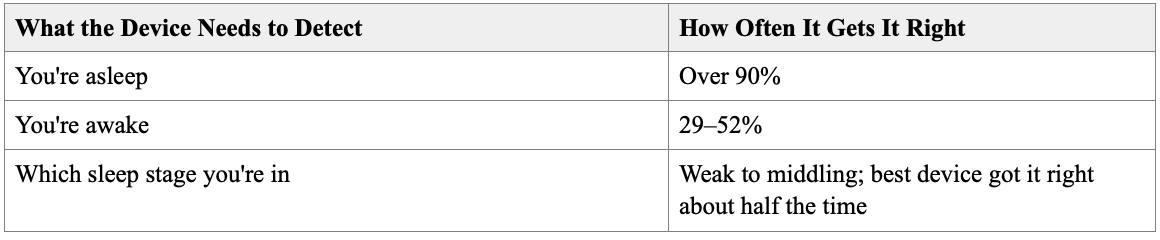
In a 2025 trial, six of the most popular devices, Apple Watch, Whoop, Garmin, Withings, and two Fitbits, were tested against real sleep-lab equipment on 62 adults.
Schyvens AM, Peters B, Van Oost NC, et al.
The middle number is the one that matters. Getting “awake” right less than half the time is worse than flipping a coin. If you're lying there awake thinking, the device usually counts it as sleep anyway.
The ring
Oura is better at the basics, credit where it's due. In an independent trial, 53 young people slept eight nights wearing both the ring and lab equipment. The ring got it right about 88 percent of the time — both for detecting sleep and for detecting wakefulness. That's meaningfully better than the wrist devices.
On sleep stages, the picture changes. It got light sleep and REM right about half the time. And most importantly: it systematically overestimated deep sleep, by somewhere between 31 and 47 minutes per night.
The deep sleep number — the one people get anxious about, bring up at dinner parties, and build entire mornings around — isn't just imprecise. It's skewed in one specific direction, by half an hour or more.
You get a precise-looking report of something that wasn't measured very precisely. And on top of that, a score that nobody outside the company has ever independently verified.
The Problem Isn't the Number. It's That You Start Trying
Sleep is one of the few things your body does worse the harder you try. You can't just decide to fall asleep. The more attention you pay to whether it's working, the longer it takes. Anyone who's lain there staring at the clock at 3am knows this mechanism from the inside.
A tracker does exactly one thing to that mechanism: it turns sleep into a performance you get graded on every morning. You go to bed with a target. You wake up to a verdict. And over the course of the day, you start planning how to get a better grade tonight.
That's not a neutral tool. It's an amplifier of exactly the kind of attention that prevents sleep in the first place.
And here's where it gets interesting. When chronic insomnia is treated properly, the first choice isn't sleeping pills. It's talk therapy, much of which is about getting people to stop trying so hard to sleep. That's the official recommendation from the American College of Physicians, backed by a strong recommendation.
So we're measuring, every night, exactly the thing the actual treatment is designed to get people to stop thinking about.
Instead: Five Things That Are Actually Backed by Evidence
None of what follows is new, and none of it is flashy. It's just what actually holds up.
1. Go to bed and wake up at the same time
If you only do one thing, do this one.
Just under 61,000 people wore a movement tracker for a week and were then followed for just over six years. Researchers compared two things: how long they slept, and how regularly they slept.
Regularity won. The most regular sleepers had roughly 30 percent lower mortality than the least regular ones. And sleep duration added nothing on top of that, once you accounted for regularity, the number of hours didn't explain anything more.
We've spent twenty years arguing over whether you should sleep seven hours or eight. What actually matters most is whether you do it at the same time. And it's free. It doesn't require more sleep — it requires the same sleep, placed in the same spot every day.
2. Cut the afternoon coffee, earlier than you think
Twelve healthy people were given 400 mg of caffeine — about two to three cups of coffee — either at bedtime, three hours before, or six hours before.
Six hours before cost them more than an hour of sleep, measured with real lab equipment.
And here's what makes this finding worth remembering: they didn't notice. Their own rating of the night was basically unchanged. The hour was gone. The feeling of having lost it wasn't.
If you go to bed at 11pm, we're talking about coffee after 5pm. For most of us, that's the afternoon cup.
3. Alcohol makes you drowsy. That's not the same as sleeping
This is the most stubborn misconception of them all, because the experience is so convincing: you do fall asleep faster after a couple of drinks.
But a pooled review of 27 studies shows something else happening to the sleep itself. REM sleep gets pushed later — by 18 minutes on average — and you get less of it, both in total minutes and as a share of the night. The effect scales with how much you drink, and it hits hardest in the second half of the night, as the alcohol gets metabolized.
That's why two glasses of wine feel like help at bedtime, and like something else entirely at four in the morning.
4. If you need an alarm clock every single morning, that's a red flag
An alarm clock isn't dangerous. But it interrupts something that would otherwise have kept going.
If you get yanked out of sleep every single day, year-round, that's telling you you're going to bed too late for the life you actually have. It's not a lack of discipline in the morning. It's a missing half hour the night before.
Move your bedtime half an hour earlier for two weeks, and pay attention to what happens five minutes before the alarm goes off. That tells you more than any number from a tracker.
5. A warm bath ninety minutes before bed
The one counterintuitive item on this list.
To fall asleep, your core body temperature needs to drop. A warm bath sounds like the wrong move — but it works precisely because the heat sends blood out to your skin, where it can release warmth. Your core temperature then drops afterward, faster than it otherwise would.
In a review of the literature, time to fall asleep dropped by about ten minutes when the bath was taken one and a half to two hours before bed. Ten minutes isn't much. But it's free, pleasant, and pointed in the right direction.
What We Can't Say
We should be honest about where the limits of this sit.
The placebo-sleep study showed that a made-up message about the night before could be measured in that same day's performance. That's not the same as showing that a year of wearing a sleep tracker makes you a worse sleeper. That study hasn't been done, and it's the direct version of the question.
We're also not saying tracking devices are useless. If you spot a pattern — that you always sleep badly after certain evenings, or that you stop breathing at night — that's genuinely useful, and it's something a doctor should look at.
What we're saying is that the device is worst at exactly the number people worry about most, and that the worry itself has a measured cost.
And the most important caveat: if you're genuinely sleeping badly, persistently, over months, the answer isn't an article. It's a proper workup. Insomnia has treatment that works, and it doesn't start with a device.
Four Things
Go to bed at the same time. The best-documented item on this list, and it beats sleep duration.
Cut off coffee six hours before bed. You won't feel the hour it costs you. You lose it anyway.
Don't use alcohol as a sleep aid. It helps you fall asleep and works against you for the rest of the night.
Put the tracker in a drawer for a month. Check in with yourself at four in the afternoon instead. That's the only measurement that counts, and you've had it the whole time.
You can't perform your way into sleep. It's the one thing your body does best the moment you stop trying.
---
Sources (All sources were looked up in the primary literature).
1. Draganich C, Erdal K. Placebo sleep affects cognitive functioning. J Exp Psychol Learn Mem Cogn. 2014;40(3):857-864. PMID 24417326. — N=164. Fabricated REM figures: 28.7% vs. 16.2%. The assigned sleep quality, not the self-reported sleep, predicted performance on the PASAT and COWAT tests.
2. Baron KG, Abbott SM, Jao N, Manalo N, Mullen R. Orthosomnia: Are some patients taking the quantified self too far? J Clin Sleep Med. 2017;13(2):351-354.
3. Schyvens AM, Peters B, Van Oost NC, et al. A performance validation of six commercial wrist-worn wearable sleep-tracking devices. SLEEP Advances. 2025;6(2):zpaf021. — 62 adults. Fitbit Charge 5, Fitbit Sense, Withings ScanWatch, Garmin Vivosmart 4, Whoop 4.0, Apple Watch Series 8. Sensitivity for sleep >90%, specificity for wakefulness 29.4–52.2%, kappa 0.21–0.53. All six are wrist-worn — no ring was included.
4. Chee NIYN, Ghorbani S, Golkashani HA, Leong RLF, Ong JL, Chee MWL. Multi-Night Validation of a Sleep Tracking Ring in Adolescents. Nat Sci Sleep. 2021;13:177-190. — Oura. N=53, eight nights each. Sensitivity and specificity both 0.88–0.89. Sleep stages: light sleep 0.52, deep sleep 0.79–0.83, REM 0.51–0.53. Overestimates deep sleep by 31.5–46.8 minutes. Rings were provided by Oura Health Oy.
5. Windred DP, Burns AC, Lane JM, et al. Sleep regularity is a stronger predictor of mortality risk than sleep duration. Sleep. 2024;47(1):zsad253. PMID 37738616. — N=60,977, UK Biobank, 6.3-year follow-up, 1,859 deaths. Highest vs. lowest regularity quintile: HR 0.70 [0.59–0.83].
6. Drake C, Roehrs T, Shambroom J, Roth T. Caffeine effects on sleep taken 0, 3, or 6 hours before going to bed. J Clin Sleep Med. 2013;9(11):1195-1200. — N=12, 400 mg. Six hours before bedtime: more than an hour of lost sleep, without participants noticing.
7. Gardiner C, Weakley JJS, Burke LM, et al. The effect of alcohol on subsequent sleep in healthy adults. Sleep Med Rev. 2025;80:102030. — 27 studies. REM latency +18.0 min, REM duration −11.3 min, REM proportion −2.8%.
8. Haghayegh S, Khoshnevis S, Smolensky MH, Diller KR, Castriotta RJ. Before-bedtime passive body heating by warm shower or bath to improve sleep. Sleep Med Rev. 2019;46:124-135.
9. Qaseem A, Kansagara D, Forciea MA, et al. Management of Chronic Insomnia Disorder in Adults. Ann Intern Med. 2016;165(2):125-133. — CBT-I as first-line treatment; strong recommendation, moderate-quality evidence.
The Oura validation above is from 2021 and was conducted on young people aged 15 to 19; more recent validations of newer models haven't been reviewed here.